58. The Greatest Sin Isn't Pride--It's Fraud: INFERNO, Canto XI, Lines 52 - 66
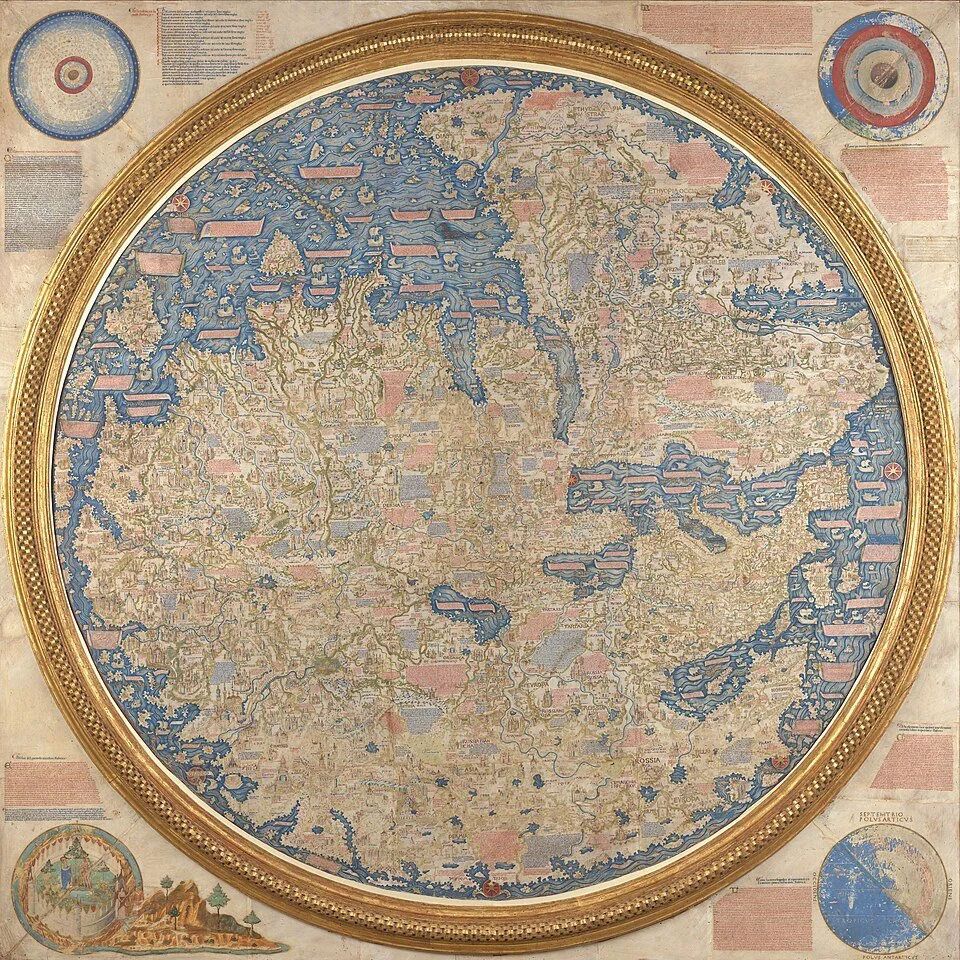
Fra Mauro’s incomparable map of the world from about 1460 CE (one of the first times in the West that Paradise is situated outside of the map of the world)
We’ve left behind the seven deadly sins as we’re moving into the lower parts of hell. But what happened to to the three sins we haven’t seen: sloth, pride, and envy?
The nature of the offenses is changing. They are more civic than theological.
And the character of Virgil is changing. He’s becoming a scholastic theologian.
And the nature of the poem seems to be changing to diagnose what’s wrong with civil society.
The bottom of hell—indeed, the bottom of the universe—is not about what humans do against God. Rather, it’s about what humans do to each other.
Consider supporting this podcast with a one-time donation or a small monthly stipend by using the PayPal button just below:
The segments for this episode of WALKING WITH DANTE:
[01:11] I read all of Virgil's map of hell, from Canto XI, Line 16, all the way up through the end of this passage at line 66. If you'd like to see my English translation of this passage, drop a comment for more conversation, or find a deeper study guide, scroll down this page.
[04:40] Virgil has become a scholastic theologian.
[09:12] I work through this specific passage, lines 52 through 66 in Canto XI. I'll give you some insights into the nature of the two sins of fraud--what's sometimes called "simple fraud" and "complex fraud."
[19:20] Perhaps the most telling thing about INFERNO is that it ceases to be primarily a theological poem and becomes more of a political one after we pass through the gates of Dis.
In this episode, I go all the way back to line 16 and read all of Virgil’s map of the road ahead. However, the specific passage for this episode is my English translation of INFERNO, Canto XI, lines 52 - 66:
People can use fraud, by which every conscience is chewed up,
Against someone who trusts them
And against the ones who have invested no trust.
The method of the latter cuts
Only the bond of love that Nature makes;
Thus, in the second circle is nested
Hypocrites, flatterers, and magicians,
Counterfeiters, thieves, and simoniacs,
Panderers, barrators, and similar garbage.
The former method of fraud wipes out
The bonds made by Nature as well as that which is added to it—
Namely, that which is created by a special sort of trust.
Therefore, in the smallest circle, at the point
Of the universe at which Dis is enthroned,
Whoever is a traitor is eternally consumed.
FOR DEEPER STUDY
Source:
The quote about trust and human society from Aquinas is found in The Summa Theologica, II:II, question 109, answer 3.
Five interpretive issues:
Although Virgil offers the rationale for the final two circles of hell, both subsets of fraud, the core definition of lo frode (line 52) remains unspecified. What is fraud? We see some of the ways it manifests: hypocrites, flatterers, etc. at lines 58 - 60. But that’s not an explanation of what it is. We also see what fraud does, gnawing on human consciences (line 52). Again, that’s what fraud does, not what fraud is. Over the course of the latter half of INFERNO, Dante will work to deepen our understanding of his baseline human error through myriad examples, monologues, discussions, and even comic sequences. But he will never offer a solid definition of fraud, leaving it up to us to define the concept after the back half of INFERNO.
Virgil seems to drop a big issue rather quietly at line 56: Fraud severs lo vinco d’amor che fa natura (“the bond of love that nature makes”). So there’s a natural bond of love between people? Does that work out in real life? Do we wish it would? In any event, Virgil seems to posit that love is the fundamental connection that creates human society . . . or perhaps should create it in the best of all possible worlds. (FYI, this call-out for love is actually a node of what will become an enormous discussion in PURGATORIO.)
One distinction between simple fraud that “only” breaks the love bond from nature and the more complex fraud that destroys a trusting relationship may be found at line 63 when Virgil claims that the more complex fraud involves a violation of a created fede (“faith”—or as I translated it: “trust”). Perhaps we could say that the simpler fraud breaks one of the key Christian virtues (love) while the more pernicious sort breaks two (love and faith).
Dis is siede (“seated”) at the center of the universe (line 65). I translated this word as “enthroned” because Dis (or Satan) is the king of this infernal realm. But you’d only know that by reading all of INFERNO (or you’d have guessed it by being a student of medieval Christian theology). However, the text is more mundane than my translation: “seated.” And it’s an interesting contrast to what comes just before: “the center of the universe.” We have a grandiose cosmological statement followed immediately by a rather ordinary seating of the prince of darkness. That tension between the magnificent and the mundane is at the heart of Dante’s art.
At the end of this whole discussion, we’ve perhaps discovered something that might otherwise slip by because it’s so common: Hell is geography. It’s not a mystical place or a metaphysical third realm. It’s not Nirvana. It’s neighborhoods connected by a road the pilgrim must walk. You might want to give this concept a little more thought. What does it show (or mean or indicate) that the afterlife can be mapped, measured, and walked? What does the notion of hell as geography tell you about the person who imagines it as such?