43. Being Human, Even In Hell: INFERNO, Canto VIII, Lines 97 - 130
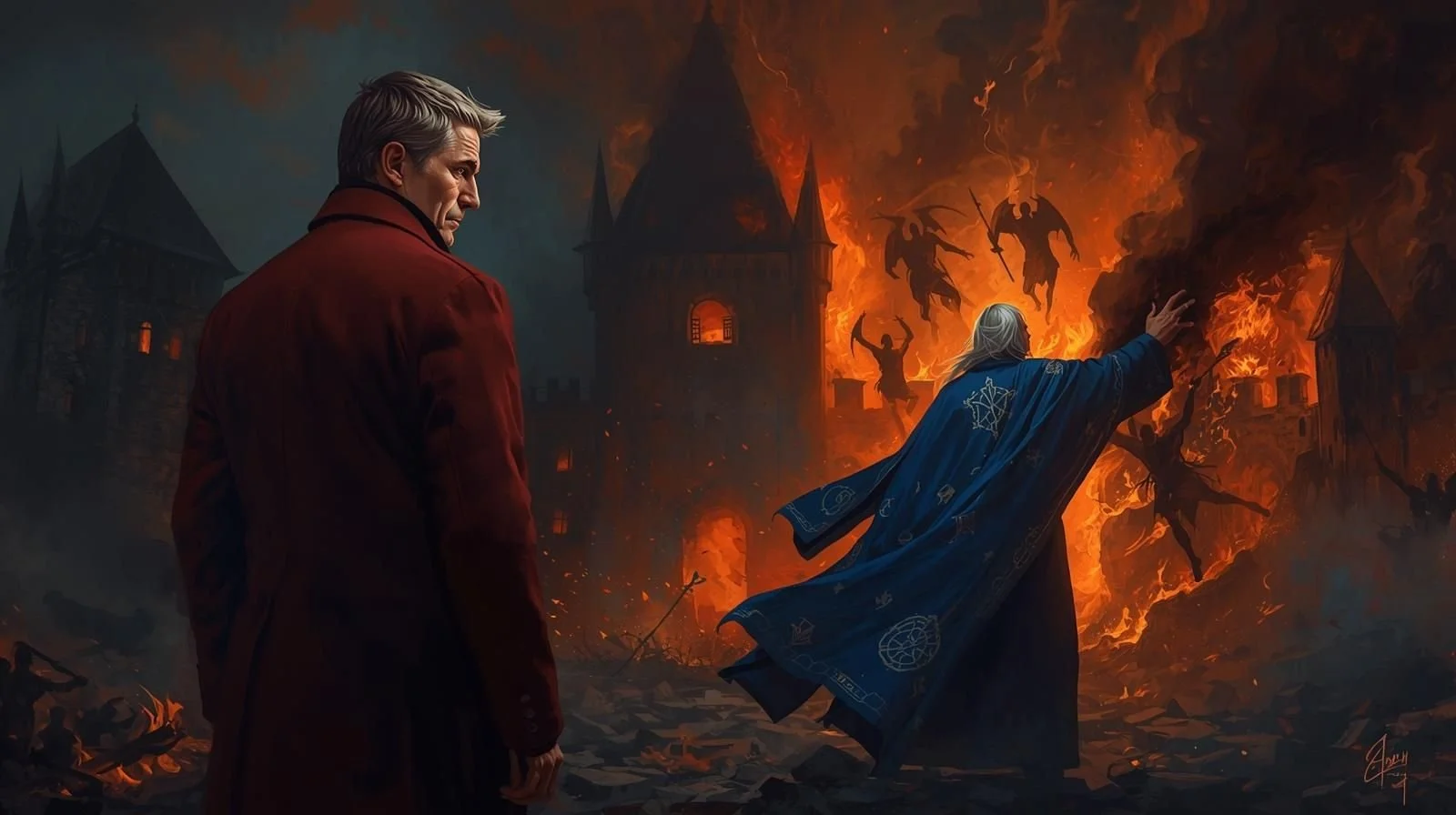
Our pilgrim alone in front of the walls of Dis.
Virgil goes off to confer with the demons. And our pilgrim, Dante, is left alone. He hasn’t been alone since the dark wood in Canto I.
For their part, the demons slam shut the gates of Dis, thereby also shutting our pilgrim out in the fifth circle of INFERNO . . . and out of his journey through the afterlife.
To compensate for the feeling that the pilgrim has been abandoned, Virgil makes a beautiful promise. At the same time, our poet seems to give him his own interiority, including a bit of a backstory not told in any classical text.
So much is changing in COMEDY. Let's see if we can tease out the human problems, not just the classical references.
To support this work, consider a one-time donation or a small monthly stipend, using this PayPal link below.
The segments for this episode of WALKING WITH DANTE:
[01:00] My English translation of INFERNO, Canto VIII, Lines 97 - 130. If you'd like to read along, continue the conversation with me about this episode via a comment, or find a deeper study guide, please scroll down this page.
[03:23] Our pilgrim's terror at being left alone (or perhaps the poet's terror at being left at the edge of Virgil's imaginative landscape).
[08:16] Virgil's response to the pilgrim: a promise never to leave him--a promise Virgil is about to break.
[11:39] The pilgrim's response--and the poet's technique of a unified point of view. Plus, Virgil's apparent doubts before the walls of Dis.
[18:22] Virgil's reply: faith and encouragement, despite his doubts, but with his backstory in tow.
[26:42] Where are we? Which circle is this? What happened to our museum of the damned?
My English translation of INFERNO, Canto VIII, Lines 97 - 130:
“Oh, my dear leader, who more than seven times
Has brought me back to safety and saved me
From the deep dangers that have pressed against me.
“Do not leave me,” I said. “How I am undone!
If the further passage is barred for us,
Let us quickly go back in our own footprints together.”
And that lord who’d led me there
Said, “Fear not! No one can stop our passage
Since it’s been granted by such a one.
But wait here for me. Let your tired soul
Be comforted and fed with good hope,
For I will never leave you in the underworld.”
So my sweet father went off and abandonned me,
And I bandied myself around
So much that yea and nay fought in my head.
I wasn’t able to hear what he proposed to them,
But he was not long among them there
Before they tried to knock each other out of the way to get back inside.
Our adversaries then closed the gates
In my lord’s face. He stayed outside
And turned back to me with faltering steps.
His eyes were on the ground and his brow, shaved
Of all its boldness, and he spoke in sighs:
“Who has confounded me at the houses of sorrow?”
And he said to me, “You, because I am irritated,
Don’t get dismayed,
No matter how they busy themselves inside to prevent our way.
“There is nothing new in their insubordination,
For they showed it once before at a less secret gate,
That to this day is without any defenses.
“You already saw the dead writing.
On this side, already down the slope,
Passing through the circles without an escort,
Comes one who will open the city for us.”
FOR MORE STUDY
Three translation problems:
In this passage, Dante uses three phrases to describe Virgil: 1) O caro duca mio (literally, “Oh dear guide [or leader] mine”—line 97), 2) quel segnor che lì m’avea menato (literally, “this lord who there me had brought”—line 103), and 3) lo dolce padre (literally, “the [or my] sweet father”—line 110). Can we trace a developmental notion through these terms—that is, from guide to lord to father? The second term (segnor) is probably the loudest in terms of Dante’s medieval, feudal mentality. Segnor brings up questions of Virgil’s status as a liege lord and of the pilgrim’s (inferred) vassal status. But that hierarchy may dissolve when Virgil returns as the “sweet father.” And even if there’s no linear development, are these three terms the competing (or complementary?) modes the poet and pilgrim need Virgil to enact?
Virgil promises not to leave the pilgrim in the lower world: ch’i’ non ti lascerò nel mondo basso (literally, “for I not you will leave in the world deep”—line 108). Nice, that, except Virgil has already promised much more. At INFERNO, Canto I, lines 118 - 120, he promised he would lead the pilgrim beyond hell and into the place where there are “those content in the fire”—which we take as a passing reference to Purgatory (although, as you’ll see, there will be little fire in Purgatory). It’s important to remember that Purgatory can in no way be called “the deep [or low] world.” So Virgil can’t be talking about a journey to that second state here. Everyone in Purgatory is headed to heaven. (COMEDY is two-thirds about the saved, only one-third about the damned.) Is this promise in Canto VIII then a limit on Virgil’s original vow? “I can get you through hell—who knows about what comes next?” Or is Virgil simply saying what needs to be said at this moment to reassure the lonely pilgrim? “There, there.” Or has the poet Dante backed up a bit on that earlier promise to wonder whether the pagan Virgil can legitimately get the pilgrim through the hyper-Christian Purgatory?
I casually mentioned the difficult language (or syntax) in Virgil’s “fear not” moment (lines 104 - 105). Here’s the passage: ché ‘l nostro passo/ non ci può tòrre alcun: da tal n’è dato” (literally, “for our step/ cannot there prevent no one: by such to us is granted”). Although medieval Florentine has quite complex sentence structure, far beyond modern English, and although pronouns are thrown in front of even double-negative verbs, these lines are still troubling, especially that second one where the poetic rhythm gets boggy. What’s more, the very last clause is ambiguous. “For by such a one it is granted to us”? (Is it then an oblique reference to God?) “For by such a step it is granted to us”? (That is, the journey, the big step, because nostro passo is singular just above). “For by such a purpose it is granted to us”? (As if at the word “tal” Virgil waves his hand around to say, “All that we’re doing!”). The meaning gets funky just when we need it most.
Four interpretive problems:
I rattled off the moments in COMEDY when Virgil (to this point) has bucked up the pilgrim. Just to be sure you see them, here’s a list of the “more than seven times” (referenced at line 97): 1) escape from the three beasts at I:49, 2) doubt over the whole journey at II:130, 3) quaking before Charon at III:94, 4) quaking before Minos at V:21, 5) fear before Cerberus at VI:22, 6) hesitation before Plutus at VII:8, 7) fear before Phlegyas at VIII:19, and 8) terror over Filippo Argenti’s assault at VIII:41. What would our pilgrim do without his guide? One of the genius points of COMEDY is that our pilgrim is not a classical hero, striding into hell (and beyond). He’s a rather human, even bumbling figure who often doubts his own path. (Just wait until he gets among the lustful in Purgatory!)
Virgil continues the thematic of Dis as a medieval city when he falters back to the pilgrim. He wonders who has kept him out of le dolenti case (literally, “the sorrowing houses”—line 120). It makes Dis seem almost domestic, no? And when Virgil finally says someone will open the “city” for them (line 130), he uses the word terra (“ground” or “land”—perhaps think “terroir” in modern English). He’s stating that someone will open this entire region, making us readers see that the challenge is not just to get into Dis but to get beyond its walls and into its “neighborhoods.” Dis is perhaps even more than a walled town. It’s a fortified region.
A lot of scholars put a more positive spin on Virgil’s leaving the pilgrim Dante in this passage. I’ve made it dire, mostly because of that stark phrase m’abbandona (“abandoned me”) at line 109. However, the subject of this verb is indeed lo dolce padre (“the sweet father). The poet could be encoding a tension in the line: the negative emotional space, followed by the positive affirmation of Virgil’s role (since the subject follows the verb in line 110). These more hopeful commentators see this moment as the first (of several) in which Virgil begins to trust the pilgrim and feels comfortable leaving him to his own devices. And it doesn’t seem as if the pilgrim Dante is too perturbed at not hearing what the demons said to Virgil (line 112). The line is rather flat and non-descriptive, without much of the pilgrim’s interiority. I could certainly be tasked with overreading the vibe here. But I still feel that my dark reading is warranted both by the earlier threat from the demons (“Find your own way back!”) and by that verb, “abandoned.”
What men segreta porta (“less secret gate”—line 125)? It has to be the “abandon hope” gate that starts Canto III, right? It surely isn’t the entrance to the castle in Limbo. No demon could or would put up a fight there. Besides, that castle’s entrance didn’t show off la scritta morta (“the dead writing”—line 127). So have the demons moved down from that first gate? Was it once better defended? Were demons up there before Jesus descended into hell and pulled those out of Limbo who deserved heaven? Is it now, after Jesus’s death and resurrection, actually easier to get into hell?
One journaling prompt:
In this episode, I said that Virgil was a good guide but not a perfect guide. Does a guide have to be perfect to be good? Can you have a fallible, good guide? When has that happened in your life, not just by a negative example (“I’ll never be like him!”), but through an actual mentor, leader, boss, or parent who was a good guide while remaining a faltering human?