44. The Witch Erichtho And The Complications In Virgil's Backstory: INFERNO, Canto IX, Lines 1 - 33
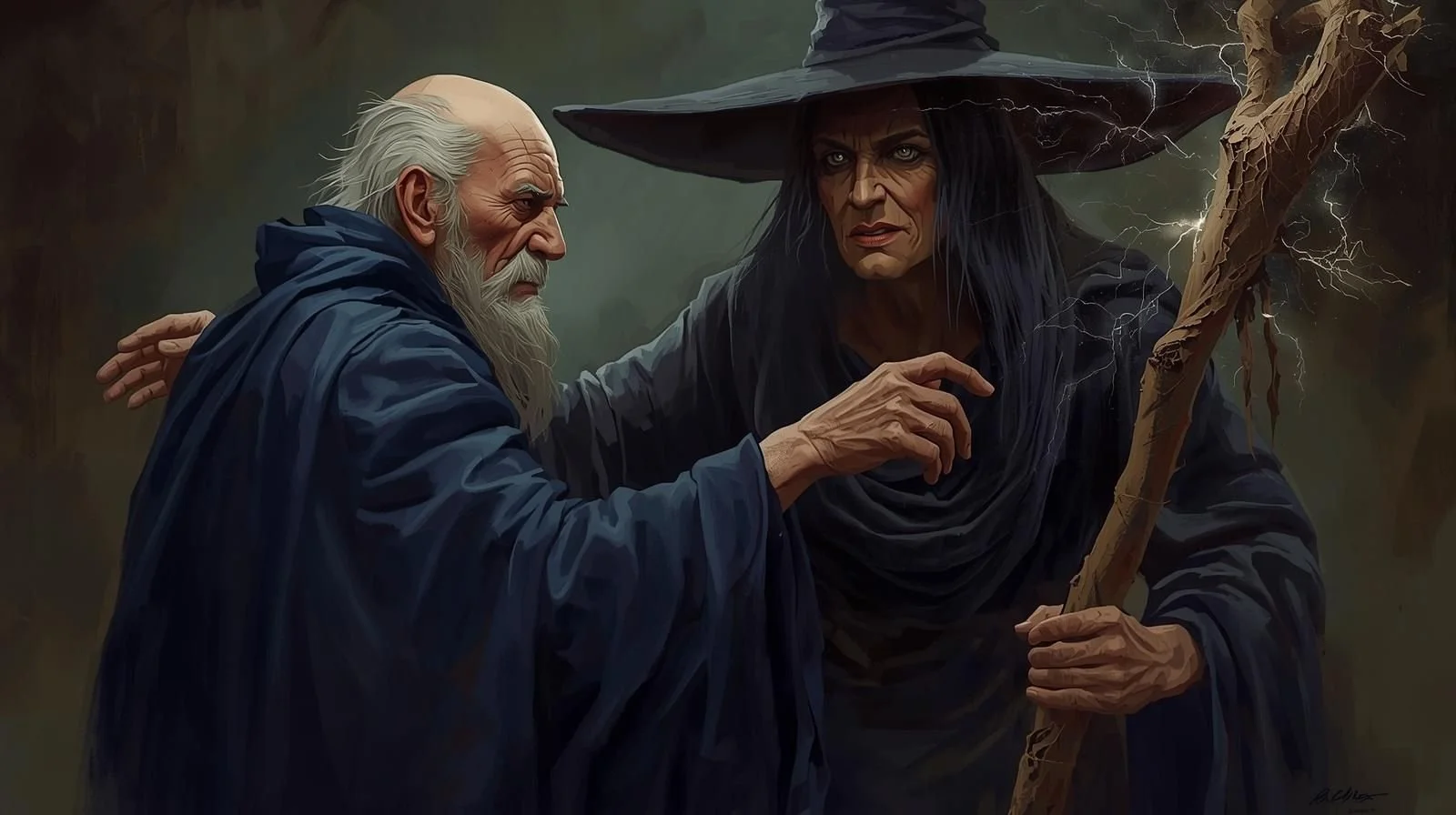
Virgil’s backstory, a strange encounter with the witch Erichtho
We left our pilgrim and his guide at the end of Canto VIII outside the walls of Dis, the city of hell. Virgil appeared to be a bit afraid but to also put a good face on it.
Now Virgil's doubts are more pronounced. (And maybe the poet's, too.)
To compensate, Virgil launches into one of the strangest moments of INFERNO: the story of his previous descent to the bottom of hell, when he was conjured by the witch Erichtho, a character from Lucan's PHARSALIA.
Virgil gets a backstory made up out of whole cloth. In other words, Virgil is becoming more human. And COMEDY is becoming more complex.
To support this work, consider a one-time donation or a small monthly stipend, using the PayPal link below.
The segments of this episode of WALKING WITH DANTE:
[01:00] My English translation of INFERNO, Canto IX, lines 1 - 33. If you'd like to read this passage, continue the conversation with me, or find a deeper study guide, scroll down this page.
[02:58] Two notes on the fifth circle of hell, the ring of wrath. One, Virgil doesn't appear to be blocked by classical figures, only Christian ones. And two, it's in the circle of wrath that parental references become most pronounced.
[05:58] Working through the passage without mentioning the witch Erichtho. Some of the passage's complexities, a moment in which the "fictional" quality of COMEDY deepens.
[17:14] The witch Erichtho. Her story in Lucan's PHARSALIA, and the ways in which Lucan rewrites Virgil's AENEID--and the ways in which Dante may rewrite Virgil. I offer seven interpretive knots Erichtho causes in COMEDY.
[25:05] Seven possible interpretations for Erichtho (and Virgil?) in COMEDY.
My English translation of INFERNO, Canto IX, lines 1 - 33:
The color that cowardice had painted my face
When I saw my leader turn back in retreat
Made him hurry up and get a grip on his own pallor.
He stopped, like a man who listens alert,
Since his eyes could not reach very far
Into the black air and the clotted fog.
“We still should be able to win this fight,”
He began, “Unless. . . . But such a one was promised.
Oh, I think it takes too long for another to come.”
I knew exactly that he had covered up
What he had started to say
And had spoken in a completely different way.
But what he said still filled me with fear,
Because I understood the broken words
To mean worse than even he intended.
“Does anyone from the first circle,
Where the only punishment is the loss of hope,
Ever get this far down into the sad pit?”
So I made this question and this: “Only rarely,”
He replied to me, “do any of us
Make the journey as I now go.
“To be honest, once before I came this way,
Conjured by remorseless Erichtho,
Who brings shades back to their bodies.
“I had not long been denuded from my flesh
When she made me enter these walls
To snatch a soul from the circle of Judas.
“There’s nowhere lower or blacker
Or farther from the heaven that wheels over everything.
I well know the way, so you can be certain of that.
“This swamp that belches this foul crap
Completely garters the sorrowful city.
We can’t get in without some sort of wrath.”
FOR DEEPER STUDY
Three translation issues:
Virgil’s doubt may be even more complex than it first appears. After he pauses mid-sentence, he continues with tal ne s’offerse (literally, “such to us was promised”—line 8). By whom? Beatrice? Or forces higher than she? And his phrasing—”such”—leaves much to be desired. What were they promised? That the journey will go on? That they’ll always win? That someone will come at moments like this? Speak up, Virgil!
There’s a gorgeous, simple line when Virgil refers to his own death: Di poco era di me la carne nuda (literally, “only a little [while] was of me my flesh naked”—line 25). Not only does this clause offer a paradoxical philosophical statement (the flesh is “naked” without the spirit—that is, it’s naked because it’s lost the deeper part of who a person is, the part one can’t see when one is in the flesh), but it also has an oblique Adam and Eve reference, since they only realized they were naked after they ate the forbidden fruit. You only really know how naked your body is once you die, as it were—that is, after you take the ultimate fall. And the poetry does all this work in easy, straightforward language. This phrase surely represents what Dante hopes for as he writes COMEDY in the common Florentine of his day.
Virgil says he had to go retrieve a soul del cerchio di Giuda (literally, “from the circle of Judas”—line 27). We’ve already encountered a similar moment of naming places farther down in hell—that is, when Francesca claims her husband can expect to end up in Caina (INFERNO, Canto V, line 107). However, we didn’t know that Caina was a circle there, only the name of a spot in hell. Now we know there are still circles below us. The scope of hell is becoming more visible as we descend. And at least two deeper circles are named after infamous reprobates: Cain, who killed his brother, Abel; and Judas, who betrayed Jesus.
Five interpretive issues:
Although Virgil’s doubts are expressed in a clipped line, the pilgrim says he understands what it all means (line 14): perch’ io traeva la parola trunca (literally, “because I comprehended the broken speech”). How does he understand? By paying attention to the words. And what does he do when he pays attention to them? He looks under them a peggior sentenzia (literally, “for a worse meaning”). In other words, it’s in close-reading or parsing words that you can find their deeper (and here darker) meaning. These two tercets (three-line stanzas, lines 10 - 15) might say a lot about how the poet Dante wants you to treat his work: by looking intently at its words to discover the meaning, rather than jumping out to Latin sources (perhaps even to Biblical ones).
Is Virgil’s problem “just” impatience? At the end of Canto VIII, he already said that someone was moving down the circles of hell to rescue them (VIII:128 - 130). Has he merely lost touch with this figure? And while we’re at it, how did Virgil know someone was coming at the end of Canto VIII? Is he psychic? Or just better in touch with the spiritual world?
There may be a second source to the Erichtho story, first mentioned by Boccaccio. In I Samuel 28:3- 25, King Saul heads to the witch of Endor to try to find out if he’s going to win a major campaign against the Philistines. She, in turn, calls up the spirit of his old friend-nemesis, the prophet Samuel, who is furious at being called back from the dead. Samuel then prophecies about Saul’s immanent defeat. There may be a way the poet is letting this Biblical story color the one about Erichtho. If so, then he might be letting us know something about a forthcoming defeat. But whose?
Let’s go back to Virgil’s surprising statement that they can’t get into the city of Dis sanz’ ira (literally, “without wrath,” line 33). I made much about Aristotle’s golden mean in the episode by talking (again) about righteous indignation. And there may be a way the rhyme scheme supports my “virtue-in-the-middle-of-the-road” interpretation. Ira is rhymed with gira (“encircles,” line 28) and spira (“crap” or “stench,” line 31—a fairly vulgar word). It could be that the poet is giving us the two ends of the spectrum, the heights of the heavenly circles and the stink of Styx in those rhymes, then moderating the poles with ira as the balance point between them, almost a syllogism in the rhyme. But there may be another way to look at this curious phrasing. Maybe ira is Virgil’s misunderstanding of divine action. After all, at the harrowing of hell he saw the heavenly force as the enemy. He may believe that whatever is willed on high would be carried out with violence and wrath in hell, rather than justice and compassion. If this second interpretation is right, then we have a further coloring of Virgil’s already complex character. (It will become my contention through PURGATORIO that Virgil is the most complex character in COMEDY.)
And one more thing about that odd mention of “wrath.” Most of the early commentators didn’t think it had anything to do with the forthcoming action of heaven. They took it to mean that Virgil was bracing himself from more from the demons. They’ve already put up a ruckus . . . and undoubtedly there’s more to come! Just FYI, almost no commentator in the modern age holds this interpretive position. Maybe we modern readers are looking for greater complexity (and irony) because that’s what we value. Maybe those early commentators were onto something.
One journaling prompt:
What causes you to lose faith, even when you know the result is guaranteed? Is it a matter of patience? Or something else?