42. The Walls Of Dis, Virgil's Limits, and Our Poet's Folly: INFERNO, Canto VIII, Lines 64 - 96
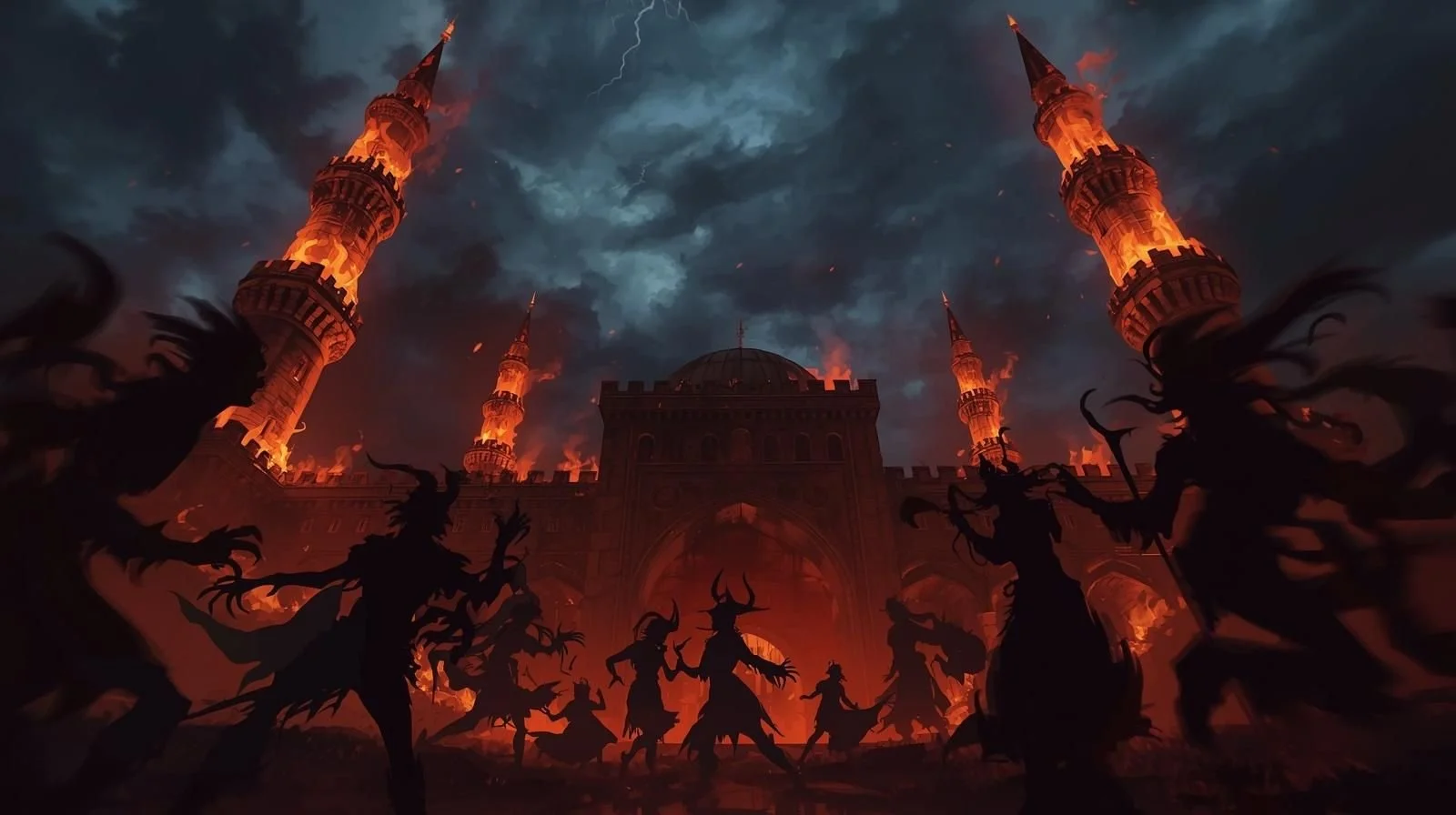
The flaming minarets at the walls of Dis.
Our pilgrim and his guide have made it across Styx, leaving behind Filippo Argenti, the wrathful, and the sullen. Our main characters have now come to the iron walls of Dis, the city of hell, with its flaming minarets.
This is more than that a geopolitical barrier. It’s also a literary barrier. Aeneas got no farther than the walls of Dis in his descent into the afterlife. So here's the farthest point that Virgil's imagination went.
Our poet must go further. Does he rally his bravado? No, his folly may well bear in on the pilgrim.
To support this work, consider a one-time donation or a small monthly stipend, using the PayPal link below.
The segments for this episode of WALKING WITH DANTE:
[01:23] My English translation of INFERNO: Canto VIII, lines 64 - 96. If you'd like to read along, continue the conversation with me through a comment, or find a deeper study guide for this episode, scroll down this page.
[04:00] Consider hell a two-part structure: 1) the moments outside of Dis and 2) the moments inside it. Those minarets of Dis may be the poet Dante's last brushstroke on a Virgilian landscape. From here on, we're going where the AENEID doesn’t (or perhaps can’t).
[13:21] Our first true-to-life demons! It can't be a mistake that we encounter them on the walls of Dis, the farthest point Aeneas (and the poet Virgil) reached in the underworld.
[14:55] Here's Dante's folly: He's going beyond his mentor and poetic father, Virgil. The pilgrim’s agitation may well represent a writer's insecurity.
[19:23] The first direct address to the reader in COMEDY, the moment in which the poet's folly may bear in on him.
My English translation of INFERNO, Canto VIII, lines 64 - 96:
There we left him. I can say no more about him,
For my ears were bashed with such a sound of pain
That I had to open my eyes wide to see what lay ahead.
My good master said, “Now, my son,
Coming upon us is the city called Dis,
With its weighed-down citizens and great army.”
And I, “Master, I already make out
The minarets there, set into the ramparts.
Those minarets are as vermilion as if they’d just been taken out of the fire.”
And he to me, “The eternal fire
From inside makes them glow red,
Just as you see in this lower part of hell.”
We finally came to the deep moats,
The outer defenses of inconsolable ground.
The walls looked to me as if they were made of iron.
It was not until we had first made a big circle
That we came to a place where the boatman yelled,
“Get out! This is the entrance.”
At the gate I saw more than a thousand
Of those who had fallen from heaven, who belligerently
Cried out, “Who is this one, who, without death,
Nonetheless traverses the kingdom of the dead people.”
And my wise master made a signal
As if to say that he wanted to talk to them privately.
Then they all checked their disdain a bit
And said, “You, come by yourself—but send that one away,
The one who came into this realm so boldly—
Let him go back along his foolish path.
See if he knows how! For you’ll remain here,
You who escorted him through this gloomy country.”
Think, reader, how I got weak in the knees
At the sound of those cursed words.
I believed I’d never make it back [from there].
FOR MORE STUDY
References:
For more information about Dis, check out the relevant passages in Virgil’s AENEID: Book VI, Lines 127ff (in which “Dis” seems the Roman name for Pluto, the god of the underworld) and Book VI, Lines 541ff (in which “Dis” seems to be the name of the underworld’s deep realm where the Cumaean Sibyl and Aeneas cannot go). Virgil indicates buildings and rather vague architectural details of Dis. Dante, on the other hand, fills in the details with those fiery minarets (and more!). Virgil never names the place a “city” per se, more like a giant edifice with walls. But Dante’s civic imagination seems to pull into high gear in this passage: We find what appears to be a medieval walled town, complete with moats (line 76) and iron walls (line 78).
The civic vision of hell is much older than Dante’s. Augustine makes reference to a “city of devils” (“civitas diaboli”—ENARRATIONES IN PSALMOS IX: 8). What’s more, it’s hard to read about “the city of Dis” without thinking of it as the opposite of Augustine’s “City Of God.” Augustine even calls the Devil “the prince of that irreligious city” (CITY OF GOD, XVIII:51, emphasis added) And Dis makes other appearances in classical literature that Dante would know. in Ovid’s METAMORPHOSES, Book IV, the ever-angry Juno crosses Styx to find herself in the city of Dis and momentarily blocked by Cerberus.
Four translation issues:
Although I translated the word meschite as “minarets” (line 70), it’s probably best translated as “mosques.” Dante, however, would most likely recognize the minaret as the most prominent feature of a mosque. Plus, a minaret looks more like the tower at the corners of a medieval walled town. My translation to “minaret” is not unwarranted but debatable.
Virgil seems to acknowledge that they’ve passed a barrier in terms of hell’s landscape. He says they’ve come in questo basso inferno (literally, “in this low hell”). The word choice seems to imply that there’s then that “higher” hell behind them.
The demons’ response to the pilgrim is a little blunter than I rendered it: pruovi, se sa (literally, “prove it, if one knows”—line 92). Their rude manner of speech shows their gran disdegno (“great disdain”—line 88).
The direct address to the reader (ll. 94 - 96) is a bit harsh in its musical tonality in the Florentine: Pense, lettor, se io mi sconfortai/ nel suon de le parole maladette,/ che non credetti ritornarci mai (literally, “Think, reader, if I was weakened/ at the sound of those horrible words,/ for I didn’t believe I’d return here ever.”). Sconfortai and credetti ritornarci, even the faltering stress on the first syllable of maladette—these discordant words and sounds may indicate the pilgrim’s, but better the poet’s dismay. And one further note: The “here” (the ci off the back of the verb ritonar) is most likely a reference back to Italy, the land of the living. We have a quick glance at the poet Dante, shivering at his desk.
Four interpretive issues:
Hell is real estate. First up, a country estate out in Limbo, far above the walls of Dis. Then a walled city (la città—line 68). As we’ll see, this city extends all the way down to the bottom of hell with infernal, public “parks” (well, thickets of gnarled trees and burning sands), as well as ruins, internal moats, and even sewage ditches. Does this geography of hell make Lust, Gluttony, Avarice/Prodigality, and Anger/Sullenness its suburbs? (In Dante’s day, the territory controlled by a town or city but outside its walls was known as the contado—about like a suburb now: distinctly connected but without many city services, with its own bureaucrats and its own enforcement mechanisms, but also a bit more “wild west” than life inside the walls. What do we make of those sinners who live outside of the geopolitical center of hell?
These are our first real demons in INFERNO. How do they show a marker between the parts of hell? We have seen angels before in INFERNO, but among the neutrals; and we were specifically told they were not “fallen”: li angeli che non furon ribelli,/ né fur fideli a Dio, ma per sé fuoro” (literally, “the angels who were not rebellious, nor were faithful to God, but were for themselves”—INFERNO, Canto III, lines 38 - 39). These demons at Dis are assurenly da ciel piovuti (literally, “from heaven fallen—Canto VIII, line 83). Are we then passing into a more Christian part of the underworld where the rules of its theology have more say-so? Certainly the sin we’re about to encounter in those walls—heresy—is a Christian one . . . and a pressing concern for the church in Dante’s day. How do these demons differ from Charon, Minos, Cerberus, Plutus, and Phlegyas? (Were those all demons?) At best, clucking Plutus was ridiculous. Minos and Cerberus seemed more terrifying, but neither compares to the threat here: “Go home by yourself, living man.” (Imagine how that works: talking Phlegyas into taking you back across Styx the other way!) And while we’re at it, if the demons are here, where’s their leader? Isn’t that Satan? (As we’ll see, probably not!)
I’ve already said that the next sin encountered is heresy. (Sorry: advancing the plot ahead of us in ways I don’t like to do.) These demons threaten to keep Virgil with them in Dis. Do they believe Virgil is guilty of heresy for taking a living man this far down into hell? There were plenty of non-canonical, New Testament-like books about descents to the afterlife, such as The Apocalypse of Peter (c. 2nd century CE) and The Apocalypse of Paul (c. 4th century CE). However, the church was invested in developing a rigorous orthodoxy in Dante’s day, a rather firm line that may have put such distinctly Christian works outside of the acceptable limits for the times. Might that line for heresy include COMEDY as well? Might COMEDY be about to stick around and commit this sin? Watch out in the passages ahead.
Notice the incantatory nature of Dante’s address to the reader in lines 93 - 96. It almost sounds like a prayer. Without telling you too much of the plot, there’s some strange magic brewing in the lines ahead of us: wands, witches, and more. We seem to be passing into an almost folkloric landscape, even at the forbidding walls of Dis. How might hell already be connected to a folkloric, fairy-tale realm, as well as keeping tabs on its Christian roots?
One journaling prompt:
How does it feel when you’re left alone with a big project? How do you keep the self-doubts at arm’s length? Or do you embrace them and make them part of the energy to carry you forward?