41. An Angry Pilgrim Among The Angry Sinners: INFERNO, Canto VIII, Lines 31 - 63
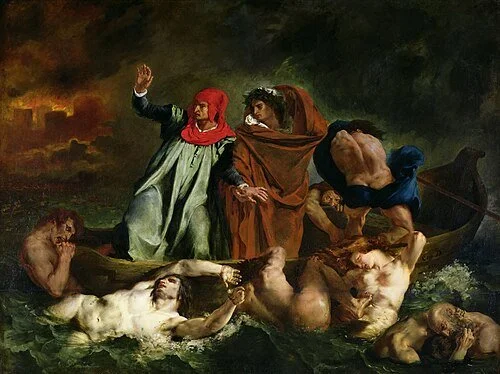
Eugène Delacroix, La Barque de Dante (Dante’s Boat—1822)
We've already been through some dramatic passages: dark woods, wild beasts, Francesca, Cerberus, Ciacco, and more. But nothing rivals crossing (the river? the swamp?) Styx in the fifth circle of INFERNO. We'll ferry across with our pilgrim and almost get capsized by one of the damned.
This passage is loaded with Bible verses, oblique references, and thematics from previous passages, as well as thematics that set up future passages. These lines deserve our slow walk to see the knots the poet sets up for us and the ways meaning is created through a complex interplay of language and images.
If you have a chance, consider donating a one-time gift or even a small monthly stipend to support this work. You can do so at the PayPal link just below.
The segments for this episode of WALKING WITH DANTE:
[01:24] My English translation of INFERNO, Canto VIII, Lines 31 - 63. If you want to see this passage, find a more in-depth study guide, or continue the conversation with a comment, scroll down this page.
[03:19] An overview of the passage, including some notes on how famous this passage has become because of its references in other works.
[05:26] A figure rises out of Styx! He and our pilgrim start a game of insults.
[12:00] Our pilgrim Dante gets angry--and Virgil approves.
[13:11] A long segment that unpacks Virgil's response to the pilgrim's anger: Bible verses, Messianic gestures, and questions about justice, divine or human.
[24:59] Filippo Argenti, the sinner from the muck, is a Black Guelph, the arch enemies of Dante and the White Guelphs . . . which means this passage is about vendetta.
My English translation of INFERNO, Canto VIII, lines 31 - 63:
As we were crossing the dead muck,
A figure covered in mud rose up in front of me
And said, “Who are you, who comes here before your time?”
And I to him, “If I come, I won’t stick around.
But who are you, who have become so gross?”
And he replied, “You see that I’m one who wails.”
And I to him, “With wailing and mourning,
Damned spirit, may you stay here!
For I recognize you, even if you’re covered in filth.”
Then he reached with both his hands for the boat,
But my wary master shoved him back,
Saying, “Over there with the other dogs!”
Then he put his arms around my neck,
Kissed my cheek, and said, “Indignant soul!
Blessed is she, who was pregnant with you.
“In the world above, he was puffed with pride.
Not one good thing graces his memory.
That’s why his shade is so furious.
How many up there think of themselves
As great muckety-mucks yet will lie like pigs in this muck,
Leaving behind nothing but horrible contempt.”
And I: “Master, I’d really like to see
This one dipped deep in the broth
Before we leave this lake.”
And he to me, “Before the shore
Lets itself be seen, you’ll be satisfied.
Such a desire should be fulfilled.”
Right after that I saw the muddy people
Rip apart that gentleman so badly
That I still praise God and thank him for it.
They all cried, “Get Filippo Argenti!”
And this crazy Florentine spirit
Chewed himself with his own teeth.
FOR MORE STUDY
Two translation issues:
There’s an telling rhyme at lines 43 and 45: mi cinse (“me enclosed”) and s’incinse (“was pregnant”). Both Virgil and the pilgrim’s mother have him wrapped up (in different ways, of course). And rhyming these words makes Virgil’s gesture seem even more parental. I wouldn’t go so far as to say that his arms around the pilgrim’s neck form a maternal gesture. But I would say that it’s like the close bond that can exist between a mother and her expectant child . . . or maybe between a father and his child. Or how’s this? Virgil parents the pilgrim to become a great poet just as his mother parented him to become a human being. They nurture him in their own ways.
The sarcasm in the passage tips over the top when the damned are called le gangose genti at line 60. While genti can mean “people,” it does carry a whiff of gentility about it, not exactly noblemen and women, but certainly people of note or bearing. Many translators try to temper this sarcasm by translating the word as “crowd” or “crew.” Frankly, it’s starker (or bolder) than that!
Five interpretive issues:
How Filippo Argenti gets named is intriguing. Neither the pilgrim Dante nor Virgil names him, although they both appear to know who he is. It’s not until the angry crowd gets at him that we discover who this is. What’s more, his name is explicitly stated, not periphrastically hinted at. My hunch is that given how war-torn Florence is, he could be any number of angry men! So the poet just has to call out which one he means in his poem. But as to how the pilgrim Dante and Virgil name and know Argenti, the problem gets stickier. The pilgrim states flat out that he knows Argenti (line 39). Then why doesn’t he give us his name? Is Dante hedging his bets, putting the final identification in the mouths of the damned? Is the poet protecting his extended family still in Florence? What’s more, Virgil seems to know Argenti, too. How could an old Latin poet know a Black Guelph? Virgil says, Quei fu al mondo persona orgogliosa (line 46—literally, “This [one] was in the world [a] person haughty”). Is saying this just a good guess on Virgil’s part? We’re among the angry so this guy must have been orgoglioso in life? Maybe, except Virgil also seems to know that nobody remembers any good about Argenti (line 47). Then Virgil makes it all more complicated by claiming his being forgotten is why he’s so angry (line 48). Really? He’s punished for something that happened after he died, tormented for his anger over having been forgotten? Let’s just say that this tercet (lines 46 - 48) remains a bit of a muddle. Is Dante making things too curt, too short-handed, trying to cram too much information into too few lines . . . so much so that Virgil’s characterization goes a little wonky and he says things the poet wants to say, becomes the poet’s puppet-like mouthpiece? Or is this all indeed the fact of the matter? Virgil does indeed know guys in other rings . . . in which case hell is a stranger place than we imagined.
I interpreted Filippo Argenti’s line—”You see that I am one who wails” (line 36)—as regret or even sadness. However, many commentators see other motives in the line: insolence (Idiot, who do expect to be in hell?), vanity (My fate is worse than anybody’s), or disdain (You think you can add to my sorrows?). We must admit it is a rather strange line without a lot of context. It seems to demand interpretation. Perhaps this line is one of those cracks that Dante intentionally leaves in his poem, a spot where the reader can enter and imaginatively fill in the details . . . and even debate its meaning with other readers.
Virgil’s praise is so effusive (even kissing the pilgrim at line 44) that we might wonder what would have happened had the pilgrim shrugged at Argenti and whistled his way across Styx. Is the pilgrim’s quick and hearty condemnation of Argenti in opposition to sloth, another of the deadly sins (that intriguingly never gets its own circle of hell and that some accuse the sullen sunk in Styx of committing)?
The passage ends with a bit of a puzzler. We’re told that boat is now more laden with the corporeal pilgrim in it, at least more so that it crosses con altrui (“with others”). What others? Charon ferries the damned into hell. But then Minos tosses them where they belong. Who needs to be ferried over Styx? Don’t the angry and the sullen just fall into it? Is Phlegyas often tasked with bringing back runaways? Is there more traffic in hell than we might imagine, damned souls leaving their circles and wandering down the rings? (There’s some evidence for this just ahead!) Or has Dante momentarily nodded off and confused Acheron and Styx?
Filippo Argenti’s “real” name was Filippo Adimari de’ Cavicciuoli. The poet is using a nickname to identify him: “silvery Filippo.” Why?
One journaling prompt:
When has anger chewed on you until you were the skeleton at your own feast? How did you get out of that danger? Or have you gotten out of it?