56. Mapping the Uncharted at the Beginning of the Age of Discovery: INFERNO, Canto XI, Lines 16 - 27
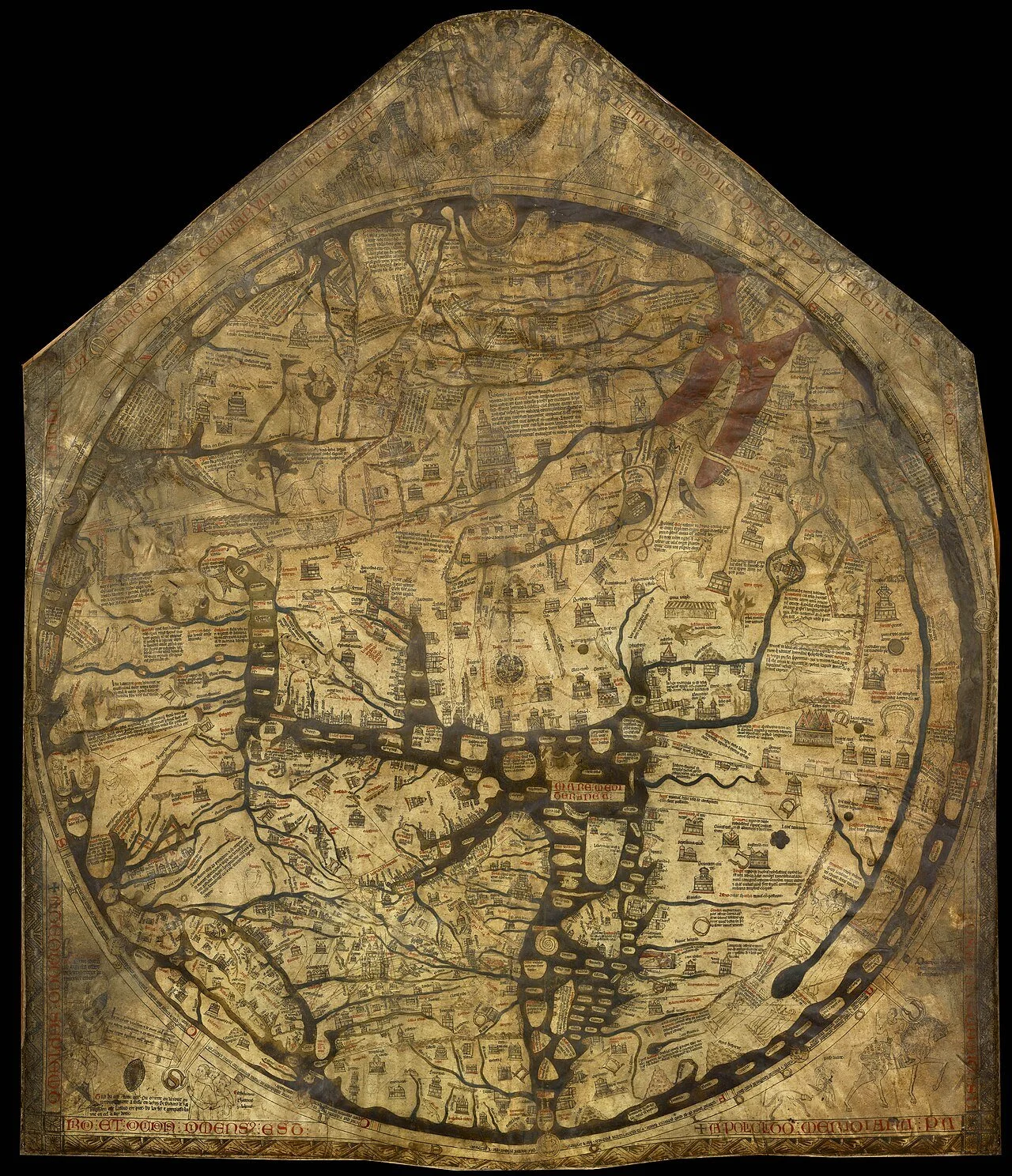
The Hereford map of the world from about 1300 CE.
As our pilgrim rests in the shade of a heretic pope’s tomb, Virgil begins to map lower hell, not by offering distances and gradient lines for the pit ahead, but by explaining injury and malice, force and fraud, the powerful combinations for the worst of human behavior.
In other words, Virgil’s map is a sacred document, not just a physical artifact—which is keeping with the nature of maps on the cusp of the age of Western exploration.
The segments for this episode of WALKING WITH DANTE:
[00:55] My English translation of INFERNO: Canto XI, lines 16 - 27. If you'd like to read along, drop a comment to continue the conversation, or find a guide for deeper study, just scroll down this page.
[03:10] What is the significance of Canto XI? Might there by medieval numerology underneath the number of the canto?
[05:06] An explication of the passage, line by line, with particularly emphasis on two words: "injury" and "malice," the keys to understanding the lowest parts of hell (or the worst of human behavior).
[12:41] One larger question from this passage: How do you recover the texts that meant so much to you in an earlier part of your life?
[17:43] A second question: Why does Virgil feel the need to map hell for the pilgrim (and us)?
My English translation of INFERNO, Canto XI, lines 16 - 27:
“My son, down inside these rocks,
He began to say, “Are three smaller circles,
A concentric gradient, like the ones you’ve just left.
“All are stuffed with wretched spirits;
But so that the mere sight of them will be enough for you,
Listen to how and why these are constrained.
“Injustice is the finish line of every evil
That picks up the hatred of heaven;
And the end of it all, whether by force or by fraud, is to hurt someone else.
“But because fraud is an evil that is especially human,
It displeases God even more; that’s why the fraudulent
Are situated lower down and more pain assails them.”
FOR DEEPER STUDY
Four interpretive issues:
We might be able to take St Thomas Aquinas’ thoughts on malice as a guide to what’s ahead. Riffing off of Aristotle’s Nicomachean Ethics, Aquinas claims that sins of malice are “non solum voluntarie, sed ex electione” (literally, “not only voluntary but also out of choice”—Summa Theologica, I - II, q. 78, a. 3). In other words, not only do you have the freedom to commit them but you also make a choice to commit them (not just fall carelessly into them, as perhaps Francesca and Paolo did when they tripped into lust). For Dante, this more engaged action of the will makes the sins ahead more dire.
If the sins ahead are about ingiuria (“injury” or “injustice”—line 25) and malizia (“malice”), what does that say about heresy, lying above this important demarcation? Does that mean heresy is not focused on hurting someone else? It would seem logical to think that heretics are intent on pulling down others with them. But maybe that’s not the case in Dante’s thinking. Are heretics damned but nonetheless well-intentioned? Why is heresy in lower hell yet left out of the sins of injury, malice, force, and fraud?
Maybe our poet pauses our descent to have Virgil map out the parts of hell ahead of us because we frankly need the help. Up until the walls of Dis, we’d been descending through the circles of the deadly (or mortal) sins: lust, gluttony, avarice (and wasting money), anger (and sullenness). Once we came through the gate of hell’s city, we left the orthodox concept of sin behind and entered a new world with heresy . . . and now we’re about to go even further from the standard sins with those of malice and injustice. Maybe when we could count off the sins, we didn’t need a map. But now we do.
And one more thing: If we’ve left behind the seven deadly sins, what does that say for the three we never encountered: sloth, envy, and pride? Why isn’t it specifically punished in hell? One standard answer in Dante studies is that all the sins we’ve already encountered involve pride in some way (Francesca’s preening, Ciacco’s disdain, Argenti’s hatred). But even if that’s the case (is it?), where does that leave envy and sloth in the tally?
Two journaling prompts:
If you had to take charge of the list of human failings, which would you include for deeper, darker condemnation after some more standard choices? If injury and malice lie at the depths of Dante’s understanding of what’s wrong with people, what lies at the depths of your understanding?
We might divide Dante’s notion of human failing into inadvertent faults and more willful ones. Admitting that some human failings are not willfully chosen may offer humans a bit of grace. “That person didn’t know better.” Do you offer the grace of the inadvertent to those around you?