60. Usury + Violence = A Theory Of Art in INFERNO, Canto XI, Lines 91 - 114
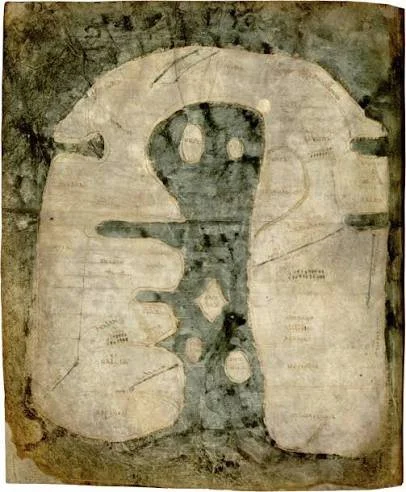
The Arabic Mappa Mundi d’Albi, oriented with the eastern Mediterranean at the top of the map
Our pilgrim has a second question about Virgil’s map of hell: Why is usury punished so far down at the bottom of the sins of violence?
The answer involves a wild conflation of Aristotle’s Physics and the Biblical book of Genesis—and oddly results in a theory of art.
No one could have predicted the map of hell ends with a theory of art.
Yet it makes sense: Canto XI explains the journey ahead, even the rationale for writing it.
Please consider supporting this podcast with a small monthly stipend or a one-time donation, using the PayPal button just below.
The segments for this episode of WALKING WITH DANTE:
[01:26] My English translation of INFERNO, Canto XI, lines 91 - 114. If you'd like to read along, continue the conversation with a comment, or find a deeper study guide, just scroll down this page.
[03:26] The pilgrim's second question: Why is usury placed so far down in hell, at the bottom of the circle of the violent?
[05:56] Virgil's reply . . . which becomes a theory of art . . . that anticipates the Renaissance.
[15:58] More on the scholastic reasoning that is behind this passage and that will structure the deepest parts of the sins of violence.
[19:11] A final temporal marker after a map of hell.
My English translation of INFERNO, Canto XI, lines 91 - 114:
“O sun, who brings health to every troubled vision,
You make me very content when you solve these things,
So that my doubts are no less pleasurable than what I know.
“But back up a little,”
I said, “to where you talked about how usury offends
Divine beneficence and pick apart that knot.”
“Philosophy,” he said to me, “when properly understood,
Notes, and not just in one spot,
How nature takes her own course
“From the divine intellect and its art.
And if you really study your Physics,
You will find, after not too many pages,
“That your own art, as much as it can,
Follows along, as the pupil follows the master.
Your art then is sort of like God’s grandchild.
“From these two, if you call to mind
The opening verses of Genesis, we find the ways
To enhance life and advance humanity.
“And because the usurer goes another way,
He disrespects both nature and her disciple,
Setting his hope in something else.
“But now follow me, for I wish to be on our way.
Pisces glitters at the horizon
And the Big Dipper lies in the direction of the northwest wind,
And our descent is still farther on.”
FOR DEEPER STUDY
Two translation issues:
Dante’s rhymes here are fascinating to consider. They start out a little crabbed and difficult in Dante’s second question: crucciata, turbata, m’aggrata (ll. 89, 91, and 93). Not terrible, just stumbling a bit, as perhaps the pilgrim is stumbling. But when Virgil gets going in his answer, the rhymes become simple, almost elementary: parte, arte, carte (ll. 98, 100, 102) or note, pote, nepote (ll. 101, 103, 105). However, right at the end of the canto, as Virgil offers the temporal markers in the heavens (which he cannot see), the rhymes get more complicated (or less melodious) again: l’orizzonta, dismonta (ll. 113, 115). You can interpret this rhyming sequence several ways: Our poet is making the poetics simpler so we don’t trip on the rhymes during Virgil’s more complicated reasoning . . . or comprehension is harder and easier in rhythm with each other in the passage . . . or the pilgrim is confused, then Virgil is bright as the sun (l. 91), and then Virgil becomes a bit more dodgy when he starts talking about constellations he can’t see. (Is the poet winking at us?) There are assuredly many other ways to interpret the rhymes in this passage.
At the end of the canto, I translated the astrological symbols so they’re make sense to us moderns, using our designations for constellations and such. In fact, Virgil says that the i Pesci (“the fishes”) glitter at the horizon (l. 113) and ‘l Carro (“the wagon”) lies in the direction of Coro (“the northwesterly wind”). Some see a pseudo-Christian reference in the fishes and the cart, references even to perhaps the Easter redemption (the Christian symbol of the fish and the cart of revelation or salvation that will ultimately appear at the end of PURGATORIO). Would Virgil know the Christian references?
Four interpretive issues:
The pilgrim begins his flattery by calling Virgil the sol (“sun”—line 91). He’s made similar moves before, as when he calls Virgil the “honor and light” of other poets (Canto I, line 82). Still, it all seems a bit over the top, given Virgil’s damned status. The sun is the source of light. Is that Virgil? What do you think is going on here?
The tercet (three-line stanza) about art and nature is quite complex. Virgil says that in Aristotle the pilgrim will find che ‘arte vostra quella, quanto pote,/ segue, come ‘l maestro fa ‘l discente,/ si che vostr’ arte a Dio quasi è nepote (literally, “that art your this, as much as it can/ follows, as a master does the student,/ such that your art to God seemingly is grandchild”—lines 103 - 105). Two quick things up front: 1) the word order of “this your art” in the first line is inverted, letting arte have the primary position; and 2) the phrase “as a master does a disciple” is also inverted with “the disciple” as the subject yet at the end of the line. Nothing too unusual here when it comes to medieval Florentine grammar, although Dante may be emphasizing certain concepts with this wording. But we should note two crucial problems. One, the “your” is plural, meaning (I guess) all of humanity, our art, especially since Virgil has just addressed the pilgrim with the singular “you” at line 102. Second, arte is repeated in the tercet, giving it supreme emphasis. Arte can be translated as “art” but also as “skill,” “craft,” “labor,” or even “occupation.” Beyond art itself, Virgil seems to be saying that all human activity should “follow” nature. (Arte is also found in line 100 to describe God’s actions.)
Notice that nature is not fallen, as it would be in Protestant or even later Roman Catholic understandings of the world. Instead, it plots its course from God’s mind and craft (lines 99 - 100).
When Virgil says the pilgrim should look in Aristotle’s Physics, he’s actually being a tad cagey . . . or perhaps collapsing a great deal into one title. Virgil’s thought seems to arise from several works: the Metaphysics (XII, 7, 1072) where Aristotle claims that nature depends on a higher principle (which a medieval would interpret as “God”); the Physics (II, 2, 194), where Aristotle claims that art imitates nature; again the Physics (VII, 5, 917) where Aristotle writes that art is the imitator of nature; and on the Nicomachean Ethics (IV, 1, 1121 - 1122) where Aristotle links usury and tyranny (and the tyrants will be among the first sinners we encounter in the circles of the violent). Aquinas picks up on all these passages, ultimately writing that making money by usury is “unnatural” (Summa Theologica, II-II, q. 78, a. 1, ad. 3).
One journaling prompt:
What is the connection between nature and art? How important is that connection? For Picasso? For modernists? Is the disconnection from nature part of the problem with modern art?