48. Straight On, Then Right For The Heretics: INFERNO, Canto IX, Lines 107 - 133
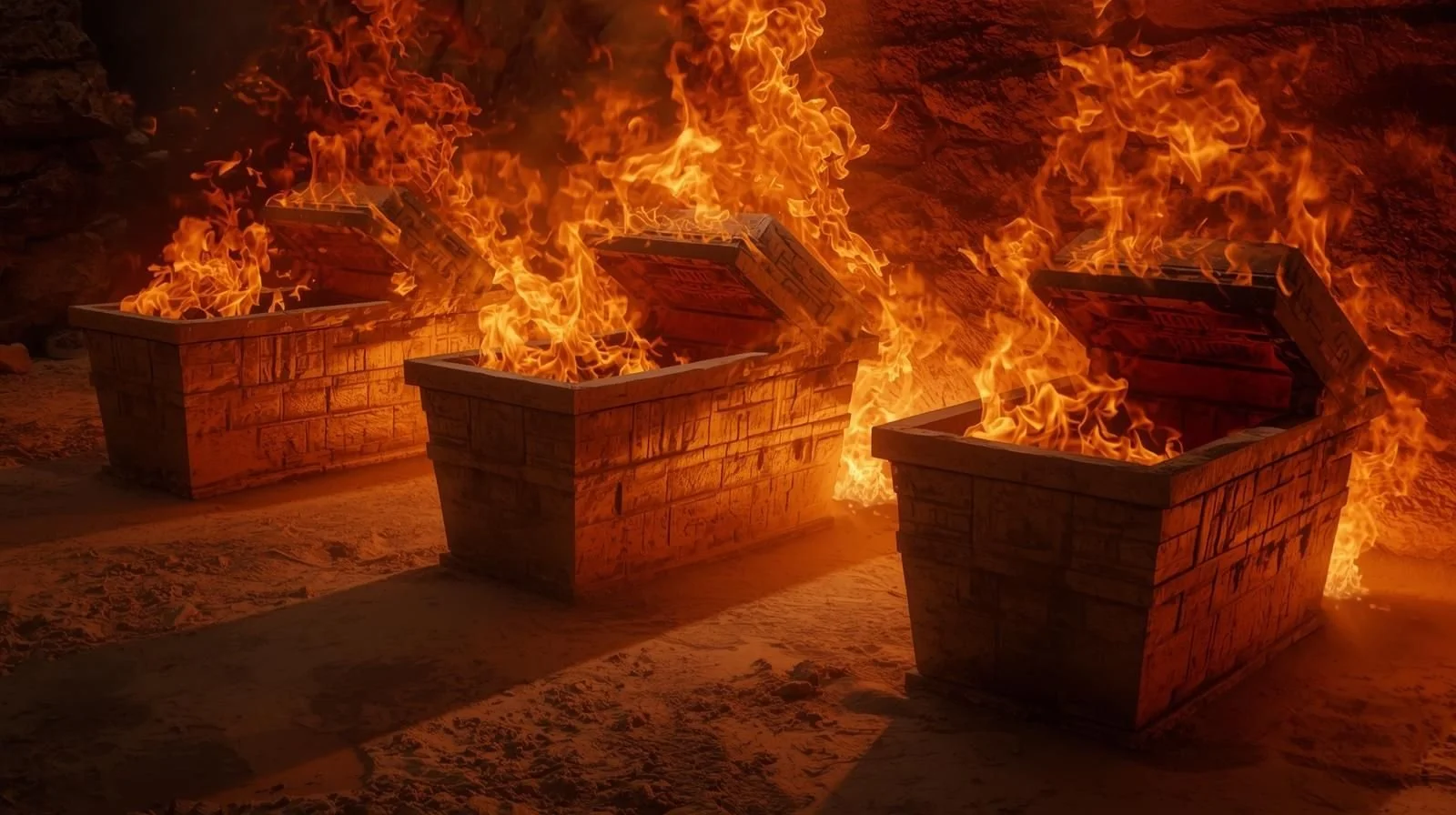
The burning sarcophagi of the heretics, just inside the walls of Dis.
Finally, we're done with the fifth circle of hell—that is, with the wrathful, the sullen, and all that happens before the gates of Dis.
Curiously, we're also done with the seven deadly sins as a structuring device for INFERNO. We now follow our pilgrim and Virgil into the sixth circle, not of envy, pride, or sloth, but of heresy.
We've come to a circle of hell that proves hard to figure out. Why heresy? And why here?
Consider underwriting some of the many fees associated with hosting, licensing, streaming, and editing this work by using the PayPal button below.
The segments of this episode of WALKING WITH DANTE:
[01:00] My English translation of INFERNO, Canto IX, lines 107 - 133. If you'd like to read along, continue the conversation with me via a comment, or find a deeper study guide for this episode, scroll down this page.
[03:48] Five general observations on the sixth circle of hell, the ring of the heretics.
[11:38] Six glosses (or notes) on this passage.
[24:26] Rereading the passage: INFERNO, Canto IX, lines 107 - 133.
My English translation of INFERNO, Canto IX, Lines 107 - 133:
And I, who had a tremendous desire to know
The condition of such a fortress,
The moment I was inside, I cast my gaze about
And saw quite a wide plain all around,
Full of grief and awful torments.
Just as at Arles where the Rhone slows down,
And at Pola right up against the Gulf of Quarnerno,
Which encloses Italy and bathes her borders,
Where the tombs made the terrain uneven,
So it was in this place on all sides,
But with one very bitter difference:
Here the tombs were checkered with fire
That heated them up so much,
No art needs the iron to be hotter.
The lids of the tombs were lifted up
And the dreadful laments that came from inside were so hideous
That they could only have come from wretchedness and pain.
And I: “Master, who are these people
Who, encased in these chests,
Make themselves felt with their suffering sighs?”
And he to me: “Here are the chief heretics
With their followers from every sect;
The tombs are so packed, you won’t believe it.
Like is entombed with like,
But the monuments are hot by degrees, some more, some less.”
He took a turn by the right hand
And we passed between the torments and the high battlements.
FOR DEEPER STUDY
Three translation issues:
The question of art is intriguing in the passage. The word occurs at line 120: che ferro più non chiede verun’ arte (literally, “so that iron much not hotter requests art”). Arte is a loaded term, both for Dante and in his day. To get close to what it means, we have to scrape off our notions of art as a spinning moment of creative perfection, lofted somewhere above us so that we can wonder at it. Yes, Dante would like us to wonder at the beauty and complexity of his poem. But his notion of arte includes good ol’ hard work. One way to translate the word is “craft” or even “technique.” You should have the idea here of artisans, or blacksmiths who beat hot metal into various forms. (Might the skill of artisan craft be a metaphor for how a great poem is created?)
The tombs’ lids are sospesi (line 121—”suspended”). I tied this word to Virgil’s state in Limbo. But there might be more to it. Is there a way that the heretics, even the damned ones, can remain open to the truth? Keep this notion in mind as we meet the great sinner who will rise up out of his flaming sarcophagus.
Most translations claim that the pilgrim can “hear” the heretics’ wails in their tombs. The verb used is fan sentir (line 126) and it can certainly mean “I am made to hear.” But although sentir is often limited to hearing, it does have a larger meaning, one connected with all of the human senses. Thus, my choice to translate it as “feel”—”they make themselves felt with their sufferings.” Perhaps things go deeper than just hearing.
Four interpretation issues:
As I stated in the podcast episode, heresy is a particularly Christian failing. In fact, the church’s rigid move toward orthodoxy in the third and fourth centuries CE brought out this notion of a pernicious, internal error that could pull many from salvation. Heretics, after all, are not non-believers in the world at large; they’re people who might once have gone to church with you. If you’d like to read more about the growing concept of heresy in Christianity, try Catherine Nixey’s book, HERETIC: JESUS CHRIST AND THE OTHER SONS OF GOD.
Dante would never have seen the Roman tombs at Arles (in southern France) or at Pola (in modern Croatia). He could only have read about them or heard travelers’ tales. But in mentioning these places, is he expanding the geographical footprint of COMEDY to include more of the world beyond Italy? Why?
And is he up to even more? Dante does often cast a narrow eye toward France (although Arles was just barely part of French rule in his day). What’s more, he might look askance at Arles since he writes COMEDY about a century after the Albigensian Crusade in Provence. Pope Innocent III had ginned that one up in the early 1200s to stamp out the Cathar heresy. Is he condemning the old order from France for heresy? Or how’s this? There was a legend in Dante’s day that the tombs at Arles held the Christian dead from Charlemagne’s disastrous incursion against Islamic forces on the Iberian peninsula in 778 CE. The martyrs were said to have been miraculously transported to those very tombs at Arles. Could that historical reference be behind the curious use of the word martìri (“torments” but with a hint of martyrdom) that helps end the canto?
The notion that the metaphor is more than a metaphor but in fact thematic to the passage will prove increasingly complex as we make our way, not only through INFERNO, but up into the heights of PURGATORIO and PARADISO. Up until now, we’ve had similes that illustrate the event being described. We can think of those leaves blown about as the damned throw themselves into Charon’s boat (INFERNO III:112 - 117). Although evocative, we wouldn’t say that “leaves” necessarily indicate anything ahead about those in Limbo or even the lustful on farther down (other than their transitory mortality and the melancholy of their fall). In this passage, however, the simile is about Roman tombs . . . which brings up questions of empire, governance, and even divine grace (since Dante believed that the founding of Rome paved the way for the birth of the Messiah). Keep these things in mind, again, as we meet the sinner ahead of us. And keep them in mind throughout the rest of COMEDY as Dante becomes more adept at writing, not only gorgeous similes, but similes that thematically prepare us for what’s to come in the poem. (By the way, there’s another way to look at the increasing complexity of the poem’s similes. My way is that Dante is learning how to write COMEDY as he writes COMEDY. But you could also say that Dante is gently educating his readers, starting with easier stuff and moving toward greater complexity as he thinks his readers can understand what he’s doing. This second stance shields Dante from any charges of “lesser” poetry and also from a developmental hypothesis . . . so that he arrives on the scene of COMEDY as a poetic genius. My stance is that we’d have to claim a lot of unseen growth from his early treatises and poems to this masterpiece. I think I can see that growth inside the masterpiece. Maybe making unseen claims is worth it to preserve the notion of holy writ; I can’t justify it from my perspective, perhaps erroneously.)
One journaling prompt:
If you’re always turning left in your journey, what does it feel like to turn right? When do you need to turn the other way? Do you do so willingly? Can you turn the other way without someone’s help?