37. Hell's Biggest Crack May Be In The Poetry, Not The Landscape: INFERNO, Canto VIII, Lines 1 - 6
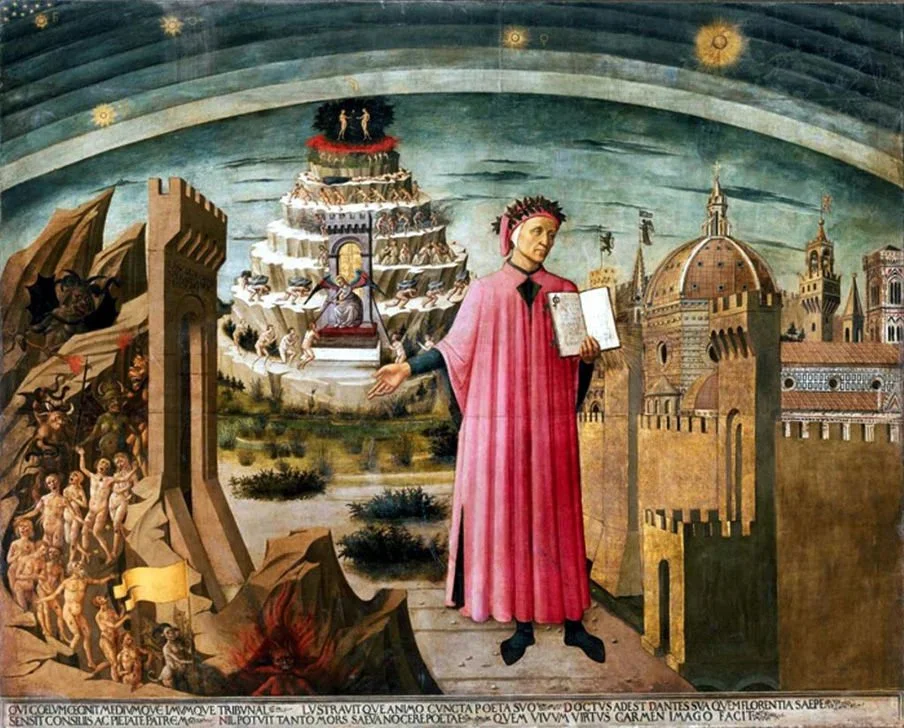
The poet stands with his poem in a painting in the Florence Duomo by Domenico di Michelino from c. 1465.
During the sequence among the wrathful, COMEDY seems to come to the conclusion of the circle, then back up and start it over again. Boccaccio had a story to explain this break, but perhaps it’s more about the poet's coming to terms with his poem’s expanding nature.
Perhaps he needs to slow down. And perhaps he needs to figure out his relationship with Virgil. To put it another way, he may need to break with Virgil ("I got the beautiful style from you") to find a powerful and deliberate poetry in the vernacular.
The segments for this episode of WALKING WITH DANTE:
[00:31] My English translation of INFERNO: Canto VIII, lines 1 - 6, plus an overview of where we've been. If you'd like to read along, find a more in-depth study guide, or drop a comment about this episode, scroll down this page.
[02:40] Boccaccio's answer to why the poem seems to shift gears: Dante left his manuscript behind.
[03:33] Some proposed answers for what I see as a shift in the poem’s narrative strategy. For one thing, our poet must come to terms with his poetic father, Virgil. THE AENEID has been taking over the poem. This emphasis needs to shift for COMEDY.
[13:33] The poet must also become more committed to the vernacular to find its voice.
[15:41] Finally, from here on out the notion of sin will change.
My English translation of INFERNO: Canto VIII, lines 1 - 6:
Continuing on, I say that well before
We got to the foot of that high tower,
Our eyes had already been directed toward its top,
Drawn by two flames that flickered up there,
And another that answered from so far away,
Our eyes could barely make it out.
FOR MORE STUDY
One translation issue:
The break may be even more pronounced than I made it in my translation. Here are the first two lines of Canto VIII: “Io dico, seguitando, ch’assai prima/ che noi fossimo al piè de l’alta torre . . . “ (Literally, “I say, following on, that even first/ before we were at the foot of the high tower”). “Io dico.” It’s so assertive, especially after we just came off of Virgil’s long sermon about the Goddess Fortune. Perhaps Dante is taking over his poem. Note, too, that it’s not “I write” or “I note,” but “I say,” a speech act, a direct connection to voice. As a side note, this canto is the first to begin with the word “I.”
Two interpretive issues:
I made a lot out of writing in the vernacular (or the common speech). But what does that look like, other than using the grammar and words of medieval Florentine? Maybe that’s Dante’s challenge: to keep up his smarty-pants technique while also writing in a more natural, vivid way.
One issue raised in the last canto and again here—and an issue that’s not answered yet—has to do with the hydraulics of hell. If Dante is going to put rivers and marshes in INFERNO (like Acheronte back with Charon), then we have to know something about what happens to that water, since the conical nature of hell will lead the water downhill. Believe it or not, Dante will become concerned with this problem in passages ahead. Maybe the hydraulics of hell are another reason he has to back up and start again with more detail.
One journaling prompt:
What does a more natural voice look like for a writer? When have you found yourself in that state of flow where the words simply move from your fingers to the screen (or page) . . . or from your mouth to your audience?