52. How To Be Human And How To Quit Being Human: INFERNO, Canto X, Lines 73 - 93
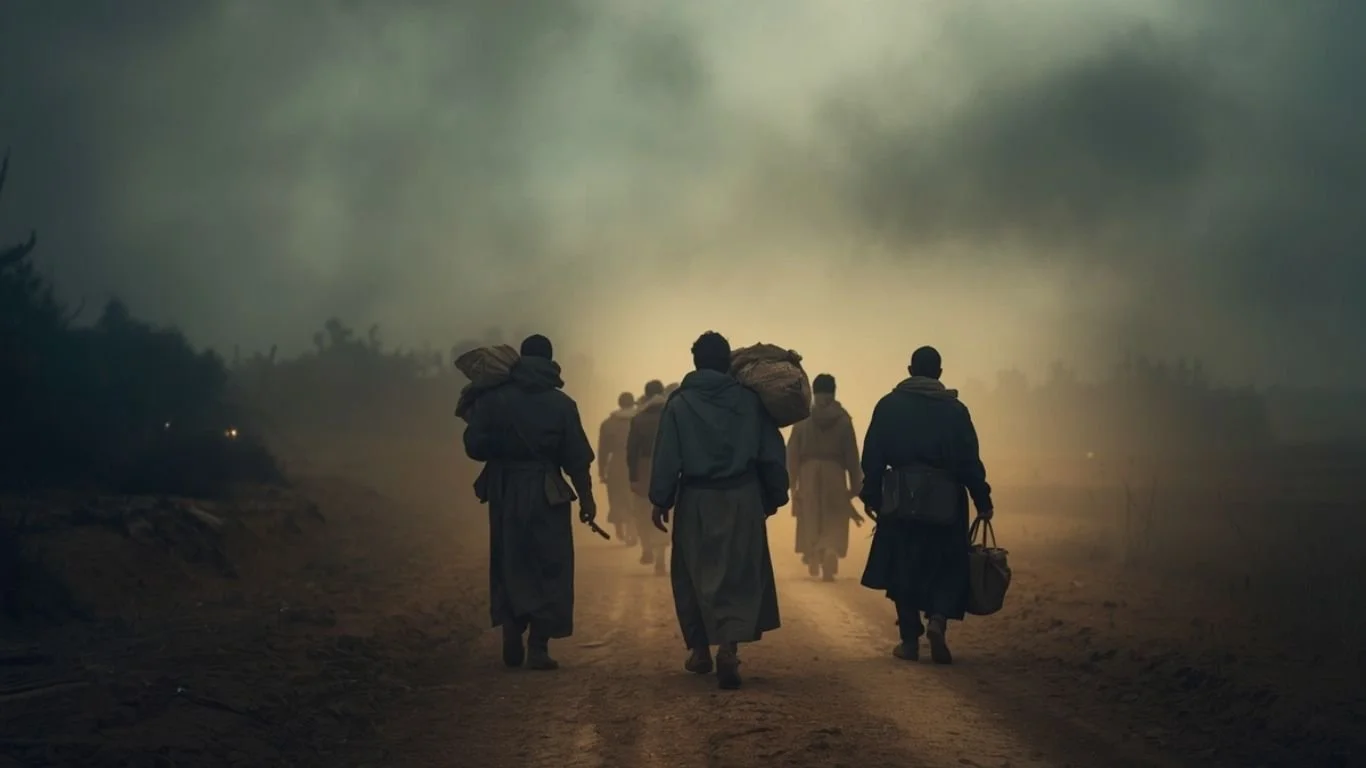
A world of exiles
As Cavalcante sinks back into the fiery tomb, lost in his fatherly grief, we realize the “magnanimo” Farinata has been standing there all along. Farinata is ready to pick up right where he left off: with another jab at our pilgrim, Dante.
Then something strange happens. Farinata begins to soften, to appear more human, to do something no Greco-Roman Stoic would ever do: He sighs.
Not so our pilgrim. He seems more than ready to fight every single point in the battle of who’s right.
But can our pilgrim hold out, especially when he’s holding onto so much guilt?
If you’d like to support this work, please consider a one-time donation or a small monthly stipend. You can do either at this PayPal link:
The segments for this episode of WALKING WITH DANTE:
[02:00] My English translation of INFERNO: Canto X, lines 73 - 93. If you'd like to see this passage, find a deeper study guide, or start a discussion about it with a comment on this episode, scroll down this page.
[04:24] A descent into the linguistic weeds, all about the term "magnanimo," used to describe Farinata and possibly a more difficult adjective that we might imagine.
[11:16] Can politics and art even talk to each other? Or do they always talk past each other?
[15:40] We're in a landscape of exiles: Virgil, Farinata, Cavalcante, his son, and even our pilgrim, Dante (as well as the poet in the shadows).
[23:43] The scope of Farinata's humanity. No, he will never become a humanist! But he does soften. There may be historical reasons for that. And structural reasons from the poem.
[27:44] How do you lose your humanity? And who is losing it in this passage?
My English translation of INFERNO, Canto X, lines 73 - 93:
But that other austere one, whose request
Had stopped me in the first place, didn’t change his facial expression,
And didn’t move his neck, nor even hitch his chest.
He just continued on from where he’d been in the first place,
Saying, “And if they have learned that art poorly,
That torments me more than this bed I’m in.
“But the face of that lady who reigns here
Will not fire up fifty times
Before you will know the moment when this art gets really heavy.
“And may it be that you return to that sweet world—
So tell me, why do those people and their edicts
Offer no leniency when it comes to my kin?”
And I to him, “Both the destruction and the great carnage
That made the Arbia turn red
Motivate these sorts of prayers in our temple.”
When he’d sighed, he shook his head
And said to me, “I wasn’t the only one, nor certainly
Without a reason would I have moved along with the others.
“But it was I alone, when all the others
Agreed to make an end of Florence,
Who stood up openly to make her defense.”
FOR DEEPER STUDY
One translation issue:
When the pilgrim talks about those prayers in the Florentine temple (line 87), he uses a loaded word: orazion. Although the simplest way to translate the word is “prayer(s),” it may be a bit more complex. If a prayer, then it’s a lofty praise hymn, beyond a mere petition. The word carries liturgical weight, making the pilgrim’s statement even more grandiose. But orazion can also mean “important speech(s).” And eligible voters would gather in Florentine churches to hold meetings and hear speeches. This double meaning may reinforce the notion that in Dante’s Florence, politics and religion had fused into a tangled (and blasphemous?) mess.
Four interpretive issues:
When Farinata says that he’s tormented more by the fate of his family than by the burning sarcophagus, he’s perhaps admitting that the pilgrim has caused him pain. After all, it’s Dante who tells him that his family hasn’t learned the “art” of return. Farinata, who died in 1264 CE, wouldn’t know the final fate of his kin . . . until he now hears it in hell. The pilgrim was previously praised for increasing Filippo Argenti’s pain in the swamp of Styx. Is he doing the same here? And is it as warranted here as it was back among the wrathful and sullen?
Farinata claims that Dante’s exile is predicated on fifty cycles of la faccia de la donna (“the face of the lady”—line 80). As I said in the episode, this “lady” is probably Hecate, a fairly shadowy figure, often seen as the queen of the underworld and often recast as Proserpine (or Persephone). She’s already come up once at the walls of Dis, when she is said to the queen of this underworld right before the Furies arrive (Canto IX: 44). Truth be told, despite being mentioned twice we never see her in COMEDY. Did Dante originally intend her to be a character in the poem, a great presence who we should have met on down in hell? Are we here seeing a node of an earlier draft or the poem’s initial conception that Dante has jettisoned? There’s no firm answer, but her presence in the early parts of INFERNO does bring up these questions.
Farinata claims Dante will also learn the art of exile, but the pilgrim already (implicitly?) knew this. The gluttonous Ciacco foretold the White/Black Guelph strife at Canto VI: 64 - 72. Given Dante’s position among the Whites, he would have assumed this strife would affect him. What Farinata adds is a more precise dating: fifty lunar cycles (X: 79 - 80). If Dante is adding to Farinata’s pain, is Farinata adding to Dante’s?
Is Farinata guilty of flattery? He says, E se tu mai nel dolce mondo regge (literally, “And may you then to the sweet world return,” or perhaps “And if ever you return to the sweet world”—line 82). Does Farinata recognize the pilgrim’s corporeality? Does he know the pilgrim is going back to the Italian peninsula? Is this part of his foretelling, as much as the fifty lunar cycles? Or is Farinata being overly gracious because he wants to get something out of the pilgrim?
Finally, one curious point. When Farinata sighs (line 88), the poet uses the exact same word that had tripped Cavalcante: Poi ch’ebbe sospirando . . . (literally, “Then having sighed . . .”). Although the meaning of ebbe isn’t here in doubt, it’s curious that it would appear in the text so close to its fraught moment . . . and in the words of the poet telling the tale, not the pilgrim speaking.
One journaling prompt:
If you’re religious, how do you untangle religion and politics in the modern world? What would a religion removed from political discourse look like?